Why China Appears Less Worried About an AI Dystopia Than the US

Hong Kong/Beijing — As artificial intelligence becomes increasingly embedded in everyday life, Americans and Chinese consumers appear to be approaching the technology with notably different levels of concern. While warnings about AI posing an existential threat have become part of the public debate in the United States, those fears appear far less prominent in China.
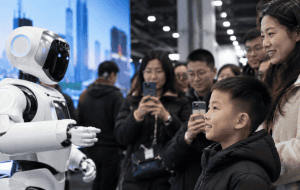
Across China, AI is already being incorporated into government services, education, hotels and other parts of daily life. Residents can interact with AI-powered digital employees when accessing local government services, students can receive immediate feedback on written assignments by uploading photographs, and hotel guests increasingly encounter robots delivering parcels directly to their rooms.
AI Adoption Is Growing Rapidly Across China
China’s widespread use of artificial intelligence reflects a broader willingness to adopt emerging technologies.
A Morgan Stanley survey released Monday found that 80% of Chinese respondents said they used AI at least once a week. In the United States, the comparable figure was 54%.
The difference comes as some American technology executives and researchers are calling for greater caution — and, in some cases, a slowdown in AI development — because of concerns that increasingly capable systems could eventually pose an existential risk to humanity.
Such warnings have become a significant part of the U.S. conversation surrounding artificial intelligence, alongside debates over job displacement, misinformation, privacy, cybersecurity and the appropriate level of government regulation.
In China, however, public attitudes appear comparatively less focused on worst-case scenarios.
AI Viewed as a Tool for Everyday Convenience
“This technology was created to serve humanity,” said Xu Jingyuan, a 22-year-old business student from Beijing. “We shouldn’t see it as something to fear, but as something that brings greater conveniences to our lives.”
Xu also expressed confidence in China’s ability to respond to potential problems, saying the government is “absolutely capable” of managing the risks associated with AI.
His comments reflected views expressed by several people interviewed by CNN this week and point to a broader difference in how Chinese and American societies may perceive technological risk.
The divide is not necessarily about whether AI carries risks. Instead, it also appears connected to differing levels of public confidence in institutions responsible for overseeing powerful technology.
Trust in Government Shapes Attitudes Toward AI Risks
Lian Jye Su, chief analyst at technology research firm Omdia, said perceptions of government oversight are an important part of the contrast.
“In the US, there is a general public perception that without whistleblowing, big corporations could escape accountability or scrutiny due to weak government oversight,” Su said.
“Whereas in China, I think there is this very strong confidence from the public that if any sh*t hits the fan, the government will step in.”
That difference in institutional trust can influence how consumers interpret the rapid expansion of AI.
In the United States, some of the world’s most influential AI systems are being developed by private technology companies, contributing to ongoing debates over corporate accountability, federal regulation and whether existing safeguards can keep pace with increasingly powerful models.
China’s approach places the government in a more prominent role in directing and regulating technology development. That environment can reinforce expectations among some Chinese consumers that authorities will intervene if emerging technologies create serious problems.
Different Societies, Different AI Debates
The contrasting attitudes highlight how the global debate over artificial intelligence extends beyond technical questions about what AI systems can do.
Public acceptance also depends on how people view companies, regulators and government institutions — and whether they believe those organizations can manage potential consequences.
China’s rapid adoption of AI suggests that many consumers currently see the technology primarily through the benefits it can provide, from faster public services to automated assistance in schools, hotels and other everyday settings.
In the United States, those practical benefits are developing alongside a more visible debate over how far AI could advance and what could happen if humans eventually struggle to control increasingly capable systems.
As both countries compete at the forefront of artificial intelligence development, their differing public attitudes show that the global AI race is not only about technological capability. It is also about trust, regulation and how societies balance innovation against uncertainty about the risks ahead.

Jacob Whitman is a contributor at Prudent Press Agency, covering a wide range of topics including news, politics, business, technology, sports, entertainment, and lifestyle. He focuses on delivering clear, balanced reporting that helps readers stay informed about current events and emerging developments. With an emphasis on accuracy, relevance, and accessibility, Jacob aims to provide useful insights and timely stories that matter to everyday readers and the communities they follow.