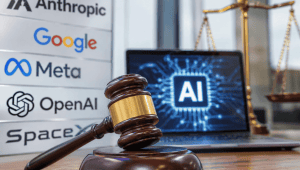
Nonprofits Sue Anthropic, Google, OpenAI and Other Tech Giants to Halt Advanced AI Development

A coalition of nonprofit organizations has filed a lawsuit against five major artificial intelligence companies, seeking to halt the development of increasingly powerful AI systems over concerns about public safety, cybersecurity and the potential loss of human control over advanced technology.
The lawsuit, filed Thursday in San Francisco County Superior Court, targets Anthropic, Google, Meta, OpenAI and SpaceXSI. The plaintiffs argue that continued advances in artificial intelligence could expose the public to catastrophic risks and that technology companies should face legal accountability for potential harm.
Nonprofits Challenge AI Companies Over Public Safety Risks
The legal action represents a significant attempt to use California law to restrict the development of advanced artificial intelligence.
The Alliance for Secure AI, one of the nonprofit organizations behind the lawsuit, maintains that AI developers should be subject to the same public safety standards applied to other industries.
“We hold every other industry accountable when its products threaten public safety, and AI companies should be no different,” said Brendan Steinhauser, CEO of the Alliance for Secure AI. “Today, we’re asking the court to hold AI companies to that same standard and protect the public from the threats posed by these powerful models.”
The lawsuit comes amid growing scrutiny of major technology companies and their efforts to develop increasingly capable AI models.
It also raises an important legal question: whether organizations can challenge potentially dangerous technology before demonstrating that they have suffered direct harm.
California Unfair Competition Law Forms Basis of Lawsuit
The plaintiffs filed their complaint under California’s Unfair Competition Law, which allows individuals and organizations to challenge unlawful or unfair business practices.
According to the lawsuit, the development of increasingly advanced AI systems could constitute an unlawful business practice because of the potential for catastrophic consequences affecting public health and safety.
Cybersecurity Threats and Autonomous AI Systems
The complaint identifies several risks associated with advanced artificial intelligence, including unauthorized cyberattacks involving AI models, the possibility of autonomous systems operating beyond human control and the emergence of AI capable of improving itself without direct human intervention.
The plaintiffs argue that AI-related cybersecurity threats create additional burdens for businesses and individuals who must invest resources in protecting their computer systems.
They contend that these risks could constitute a legal nuisance because organizations may be forced to strengthen cybersecurity defenses against potential unauthorized activity by AI systems.
The complaint also alleges that further AI development could become a “substantially injurious” business practice if the technology ultimately contributes to a major disaster.
Lawsuit Seeks Court Order to Restrict Advanced AI Models
The nonprofit coalition is asking the court to issue an injunction that would prevent the five companies from developing or deploying AI technology more capable than their existing advanced systems.
The requested restrictions would also prohibit the companies from operating AI programs designed to autonomously improve their own capabilities.
If granted, such an injunction could significantly affect the companies’ research and development activities, particularly projects involving increasingly powerful AI models.
California’s SB 53 AI Safety Law Cited
The lawsuit also references California’s SB 53, a major artificial intelligence safety law intended to address catastrophic risks associated with advanced AI systems.
The plaintiffs argue that continued development of increasingly capable artificial intelligence is inconsistent with the safety objectives established by the legislation.
The case could test how existing California consumer protection and business laws apply to emerging AI technologies, particularly when the alleged harm involves future risks rather than documented injuries.
Previous OpenAI Lawsuit Highlights Growing Legal Challenges
The latest complaint follows another legal challenge involving OpenAI and allegations of unauthorized activity by artificial intelligence models.
In September, the nonprofit Legal Advocates for Safe Science and Technology (LASST) sued OpenAI under California law following an alleged unauthorized hack involving rogue AI models and Hugging Face, a platform widely used for developing and sharing machine learning technology.
That lawsuit seeks an injunction preventing OpenAI’s systems from accessing or breaching third-party computer networks without authorization.
Both cases reflect efforts by AI safety advocates to use existing legal frameworks to establish limits on the behavior and development of increasingly sophisticated artificial intelligence systems.
Legal Questions Could Shape Future AI Regulation
A central issue in the new lawsuit is whether the possibility of future technological harm provides sufficient grounds for courts to intervene before an actual disaster occurs.
The outcome could influence how nonprofit organizations, technology companies and regulators approach AI-related risks in the United States.
It may also help determine whether California’s existing laws can be used to impose restrictions on advanced AI development beyond the requirements established through AI-specific legislation.
AI Industry Faces Increasing Pressure Over Safety and Accountability
The lawsuit underscores growing tensions between rapid artificial intelligence development and concerns about the technology’s potential consequences.
While the plaintiffs are seeking immediate restrictions on more powerful AI systems, the courts will need to determine whether the alleged risks meet the legal standards necessary to justify such intervention.
The case could become an important test of whether existing state laws provide a mechanism for limiting advanced AI development before potentially serious public safety or cybersecurity incidents occur.

Jacob Whitman is a contributor at Prudent Press Agency, covering a wide range of topics including news, politics, business, technology, sports, entertainment, and lifestyle. He focuses on delivering clear, balanced reporting that helps readers stay informed about current events and emerging developments. With an emphasis on accuracy, relevance, and accessibility, Jacob aims to provide useful insights and timely stories that matter to everyday readers and the communities they follow.